
McDowell Projected Versus Actual Release
NCDAC uses the exact label “Projected Release Date” in a state prisoner’s incarceration summary and sentence history. It is an estimate based on the information then in the agency’s system. The same history can later show an Actual Release Date. Actual means the state custody event occurred as recorded. It does not always mean that every sentence, hold, or supervision duty ended.
A person can leave prison for post-release supervision. In that event, the incarceration field may become inactive while the separate supervision field stays active. A transfer to another prison or authority is not release to the community. Likewise, a county jail booking can end through bond, a court order, time served, a state commitment, or transfer. Each path produces a different record.
Pretrial detention is the key exception. A person held at McDowell County Detention Center before judgment has no sentence-based date to calculate. A bond order can permit release while the case remains pending. Another warrant or detainer can still prevent physical departure. The Sheriff and McDowell court case are the proper sources.
Find a McDowell Release Date
Start by identifying the custody type. The NCDAC offender search covers state prisoners and state community supervision, but it expressly excludes county-jail data. Search fields include name, Soundex, offender number, status, demographic details, exact or ranged birth date, and age range. A state record can display the projection within its incarceration and sentence details.
- Decide whether the person is in the McDowell jail, an NCDAC prison such as Marion Correctional Institution, or another system. Do not use a county roster for a state prisoner.
- For NCDAC custody, search by offender number when known. Otherwise use the legal name and birth information to narrow the match.
- Open the profile and read the Projected Release Date with the sentence history, offense date, status, county, and docket. Do not copy the date without matching identity.
- For a county sentence, obtain the judgment and credit order from the McDowell Clerk, then ask the jail custodian for its working calculation.
- On or after the expected event, return to the responsible source and look for Actual Release Date, release type, status, or a transfer destination.
The McDowell County Courthouse preserves the judgment and later court orders. Portal can show case events and disposition, yet it cannot certify the moment a person left the building. For the county jail, call the detention line at 828-652-2236 and seek the written booking/release record when historical proof is needed.
Open the official NCDAC offender search to see the state-record entry point.
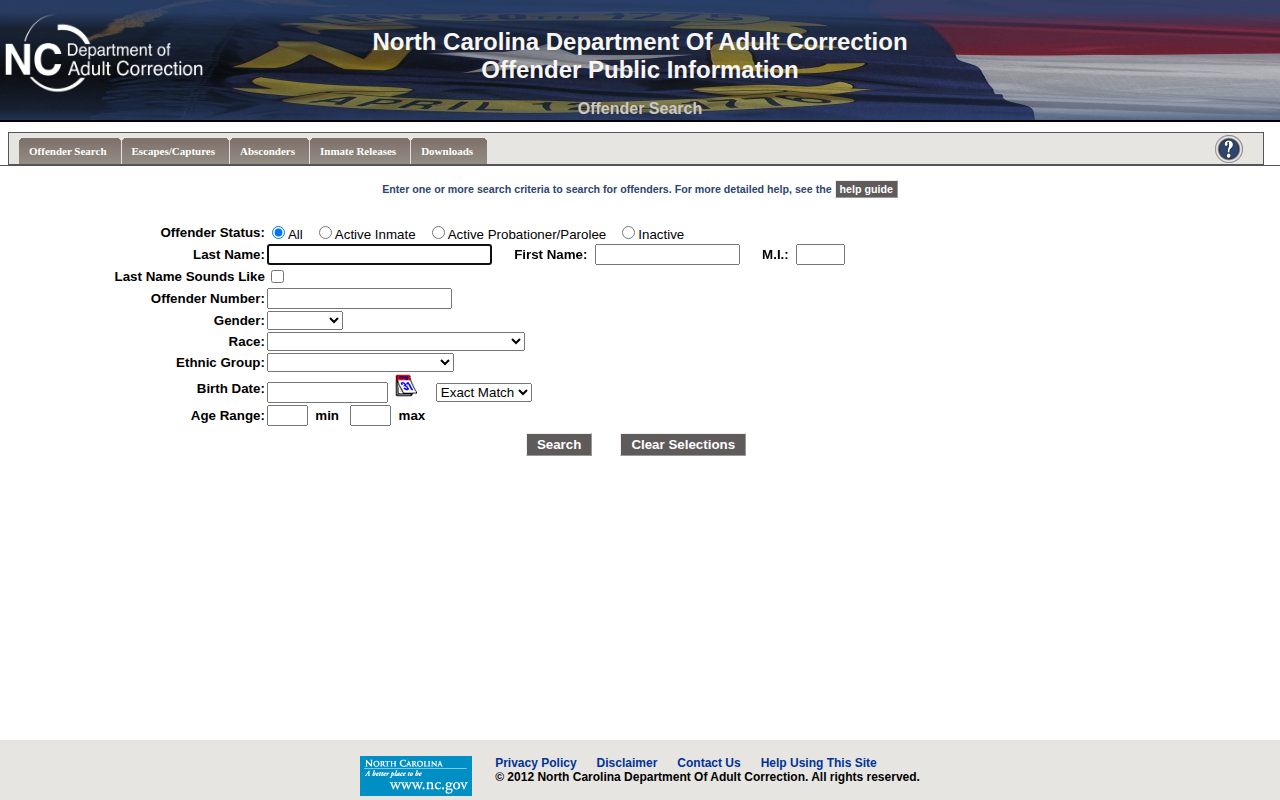
This statewide search is appropriate for NCDAC custody or supervision, not a person whose record exists only in the McDowell County jail.
Note: A projected state date should always be read with the offender number and status because a same-name match can point to another person.
McDowell Release Date Sentence Rules
North Carolina’s Structured Sentencing calculation begins with the judgment’s minimum and maximum terms. Under G.S. 15A-1340.13(d), an active felon must serve the imposed minimum. Earned time can reduce the maximum side, but never below that minimum. The sentencing tables in G.S. 15A-1340.17 help define the lawful minimum-to-maximum relationship. Credited pretrial custody, consecutive terms, offense class and date, and special rules must also be read from the case.
North Carolina’s official parole-process explanation says Structured Sentencing offenders serve at least 100 percent of the minimum and 85 percent of the maximum before PRS. That statement describes the statutory sentence structure. It is not a formula that permits someone to multiply a printed sentence by .85 and announce a date. The result could be wrong if it ignores the minimum, jail credit, sentence order, earned-time changes, PRS offsets, or an exception.
A safe estimate is the current NCDAC Projected Release Date. It has already been produced within the agency’s sentence administration system, though it can still change. The court judgment remains essential when a term was resentenced, vacated, made consecutive, or credited in a later order.
McDowell Prison Release Into PRS
For covered Structured Sentencing felons, release from prison can begin post-release supervision rather than end the sentence. G.S. 15A-1368.2 generally sets release to PRS at the maximum less twelve months for Classes B1 through E, or nine months for Classes F through I, less authorized earned time. Certain reportable offenses use a sixty-month offset. These are statutory rules, not a universal calculator.
PRS explains why an NCDAC profile can show physical release from prison alongside an active supervision status. Completion of PRS terminates the sentence under the statute. Until then, “released” and “fully discharged” are different statements. The McDowell parole and probation page explains how to read the separate community-supervision fields.
Marion Correctional Institution is a state prison in McDowell County. Its projected and actual releases belong in NCDAC history, not the Sheriff’s booking records. A move from Marion CI to another prison is an institution transfer. County location does not turn that event into a McDowell jail release.
McDowell Jail Earned-Time Limits
A sentenced misdemeanant held locally follows a different framework. G.S. 15A-1340.20 states that an activated misdemeanor sentence generally serves each day except authorized work and earned credits. The combined award is capped at four days per month. G.S. 148-13 directs NCDAC earned-time rules to administrators of local jails for sentenced prisoners.
McDowell County publishes no individual calculation sheet or online local projected-date field. The Clerk’s judgment supplies the sentence and the credit order. The McDowell County Detention Center supplies the working and actual release calculation. A pretrial detainee does not gain a projected release date merely because the person has spent time in jail. Sentencing, bond, court orders, and holds govern that separate situation.
Fair Sentencing rules also differ. NCDAC says good time may credit a day for a day of good behavior in covered cases, and the credit can be lost. Merit time, work, and program status can affect the agency’s calculation. Apply only the framework that fits the offense and sentence date.
Note: McDowell has no published local worksheet, so only the jail custodian should state the current county-sentence computation for a named person.
Why McDowell Release Dates Change
NCDAC warns that a Projected Release Date can change. Some changes are routine sentence administration. Others come from a court, a new case, or a receiving authority. The direction of a change cannot be guessed from a single status line.
| Factor | Possible effect | Record to check |
|---|---|---|
| Earned time or program status | An award may move the projection earlier; loss or removal may move it later | NCDAC sentence history and current projection |
| Discipline | Loss of eligible credit may extend the expected prison stay | NCDAC current calculation |
| Jail-credit correction | Credited time can change the computed term in either direction after correction | Court order and NCDAC or jail calculation |
| New or consecutive sentence | Another term may extend custody | Judgment, docket, and sentence history |
| Resentencing or vacatur | A new lawful judgment may shorten or extend the projection | Filed court order and updated custodian record |
| Detainer or other hold | The sentence may end while another authority takes custody | Custodian release record and receiving agency |
| Parole decision | An eligible older-law case may receive, lose, or change a release plan | Commission result and NCDAC actual status |
A detainer is a request or hold from another authority. It can prevent community release even when one sentence reaches its date. McDowell’s jail houses U.S. Marshals Service detainees, so a federal pickup is a real local boundary. Ask which agency received the person. “Gone from McDowell” is not proof of community release.
McDowell Release Is Not Simple Math
The distinctive North Carolina rule is easy to misstate. A projection does not come from one percentage. The minimum term is a legal floor for an active Structured Sentencing felony. Earned time operates against the maximum without reducing service below the minimum. PRS offsets then govern release from prison into community supervision for covered cases.
Jail credit, work or program status, discipline, consecutive judgments, sentence corrections, and special statutes can all change the result. Offense and sentence dates determine which law applies. That is why the official NCDAC Victim Support Services guidance calls the date projected and warns that it may change.
The official NCDAC victim-support page provides the state’s projected and actual release-date guidance.
The official wording supports using the projection for planning while reserving final confirmation for the custodian’s actual event record.
Confirm McDowell Actual Release Dates
On the expected date, check the same system that produced the projection. For an NCDAC prisoner, compare the Projected Release Date with Actual Release Date, inmate status, supervision status, and facility. The dedicated NCDAC Inmate Release Search can also select McDowell by year and month and can show Release Date and Type of Release. Its “Release County” is an NCDAC designation, not a Sheriff booking list.
For a county sentence, contact the McDowell Detention Center and request the written release entry. For a court change, obtain the order from the Clerk. NC SAVAN/VINELink may send a pending or actual custody alert, but an alert is not a certified release record. The McDowell VINELink check can help track an event, followed by direct confirmation from the Sheriff or NCDAC.
A released result also requires a custody-boundary check. BOP, ICE, USMS, another county, or another NCDAC institution may hold the person. Actual release from one record closes that source’s episode. It does not rule out another authority.
The Sheriff’s detention page identifies the local facility channel, while the Sheriff contact page supplies the written-contact route. Neither publishes a county projected-date calculator. For state records, the NCDAC Inmate Release Search can corroborate an event designated to McDowell after release, but it does not convert state results into county jail records.
Keep a copy of the date observed, the reporting agency, offender or booking number, and the later actual event. If the projection changes, compare the updated custodian record with any new court order. This creates a traceable timeline without guessing why an unexplained change occurred. It also keeps a state projection distinct from a local jail calculation.