
Understanding McDowell County Releases
“Released” records the end of one custody episode. It does not always mean a person is free of all physical custody or legal control. A McDowell County Detention Center booking may end through bond, a written promise, court order, dismissal, time served, sentence expiration, extradition, or transfer. NCDAC may accept a person after a felony commitment. The county jail can also release a federal detainee to the U.S. Marshals Service. Each outcome sends the search to a different office.
A transfer is especially easy to misread. Someone removed from the county’s current inmate channel might enter state prison, another jail, federal custody, or immigration custody. Parole and post-release supervision end confinement but continue supervision in the community. Probation may begin as a court sentence without a prison release at all. A sound finding names the releasing agency, the episode, the recorded disposition, and the authority that received or supervised the person next.
- Discharge
- The end of a custody or sentence status recorded by the responsible agency.
- Time served
- A release tied to custody time already credited toward the sentence.
- Transfer
- A move between authorities or facilities, not a community release.
- Post-release supervision
- The required community portion that can follow a North Carolina prison term.
McDowell County Release Types
The release type determines what can be proved and where the next record appears. A court case can stay open after bond, while a dismissal can occur before or after a person leaves the jail. An NCDAC transfer begins a state episode. A federal pickup continues federal custody. The table keeps those paths separate.
| Recorded outcome | What it means | Best next source |
|---|---|---|
| Bond or written promise | Physical release while the case may remain pending | Sheriff release record and McDowell court case |
| Court order or dismissal | A court action affects custody or the charge | Filed order plus Sheriff release time |
| Time served or expiration | The county sentence or custody term ends | Booking/release record and judgment |
| NCDAC commitment | County custody changes to state custody | NCDAC offender profile |
| USMS or ICE pickup | Another authority receives the person | Receiving agency, federal docket, BOP, or ICE |
| Parole or prison release | Confinement ends, often with supervision | NCDAC actual release and supervision fields |
Death can also close a custody episode, but it must never be recast as ordinary release. Likewise, minimum custody and work release are prison classifications or programs. They do not prove that a sentence has ended.
McDowell Release Record Fields
The Sheriff does not publish a web field schema, so a request should seek named, existing items rather than assume every field is maintained or open. A county booking/release record can connect identity, the arrest episode, court references, and the event that ended county custody. The booking photo belongs to the arrest event and does not prove guilt, present custody, or a later release.
| Field | What it can show |
|---|---|
| Name and identifiers | Which person and booking episode the record concerns |
| Booking or SO number | The local episode used to route a precise request |
| Booking date and time | When county custody was recorded |
| Charges and docket numbers | The court matters tied to the booking |
| Bond type and amount | Terms recorded for a possible bond release |
| Release date and time | The operational end of that county custody episode |
| Disposition and authority | Why the episode ended and who authorized it |
| Transfer destination | The next authority or facility, if disclosable |
NCDAC provides a more defined state profile. It may show an inactive incarceration status while probation, parole, or post-release status remains active. Sentence history can include the offense, docket, commitment date, projected date, actual release date, and punishment type. Read incarceration and supervision as two separate facts.
Request McDowell Release Records
No dedicated Sheriff release-record form, local fee schedule, promised turnaround, or retention table is published. A focused written request may be mailed or delivered to the Sheriff’s Office. The contact form can help with routing, while the detention line is best for an immediate current-status question. Ask for electronic copies and advance notice of any cost.
- Identify the full name, date of birth if known, approximate booking date, and booking number.
- Ask for the existing booking sheet and recorded release date, time, type, authority, bond information, and transfer destination if disclosable.
- Request the booking photograph only when it is part of the specific arrest episode sought.
- Ask for electronic delivery, a cost estimate before work begins, and the legal basis for any withheld portion.
- Compare the response with the filed court order or the receiving agency’s later record.
593 Spaulding Road
Marion, NC 28752
Main: 828-652-2235
Detention: 828-652-2236
Monday through Friday, 8:30 a.m. to 5 p.m.
The official Sheriff contact page provides the inquiry channel and office location. G.S. 132-6 calls for inspection at reasonable times and copies as promptly as possible. Under G.S. 132-6.2, ordinary uncertified copy charges generally cannot exceed direct reproduction cost, though an unusually extensive request may support a special service charge. The office need not create a new list that does not exist.
McDowell Release Record Limits
Online display is not the same as legal retention. McDowell County publishes no rule for how long a person appears in the Sheriff app and no local retention period for booking/release records. North Carolina records can be destroyed only through authorized schedules under G.S. 121-5. NCDAC’s general history reaches back to 1972, but the dedicated release form currently offers recent rolling years. That interface range is not a legal retention promise.
Sealed or expunged records require more care. North Carolina expunction can remove and seal or destroy qualifying arrest, charge, or conviction records, with eligibility controlled by the specific law and case outcome. A missing eCourts case does not prove expunction, innocence, release, or that no case existed. For a qualifying petition, the court where the charge or conviction occurred is the key source.
Roster absence is not a release record. It can reflect release, transfer, data lag, a name mismatch, or a new authority taking custody.
McDowell Bond Release Verification
No official county bond schedule or local pretrial-services program was found. Bond must be read from the case-specific order. The McDowell Clerk can locate court records, Magistrates handle judicial functions tied to initial proceedings, and the after-hours line serves times when the courthouse is closed. Bond release means the person left custody under conditions while the criminal case may continue. It does not mean a charge was dismissed or an acquittal occurred.
The Sheriff release record supplies the operational exit event. The court order supplies its legal basis. The McDowell court contact directory lists the Clerk at 828-655-4100, Magistrates at 828-655-4119, and the after-hours magistrate line at 828-652-4000. When dates conflict, compare the time each agency recorded and ask for the filed order rather than relying on a summary label.
McDowell Release Court Records
McDowell now sits in Prosecutorial, Superior Court, and District Court District 41. Older references to District 29A are stale. North Carolina completed its statewide eCourts rollout, so an anonymous Portal Smart Search can preserve the legal sequence after a person drops from a live custody view. Useful entries include bond orders, hearings, dispositions, judgments, probation, and financial events. “Closed” is a case status, not a jail-door timestamp.
The North Carolina eCourts entry page leads to Portal access. Search McDowell County and criminal actions, then use names, date of birth, case status, or filing dates to separate similar records. The McDowell County Courthouse is the source for filed paper records and public terminals.
The official courthouse view shows the local record source used to explain a release event.
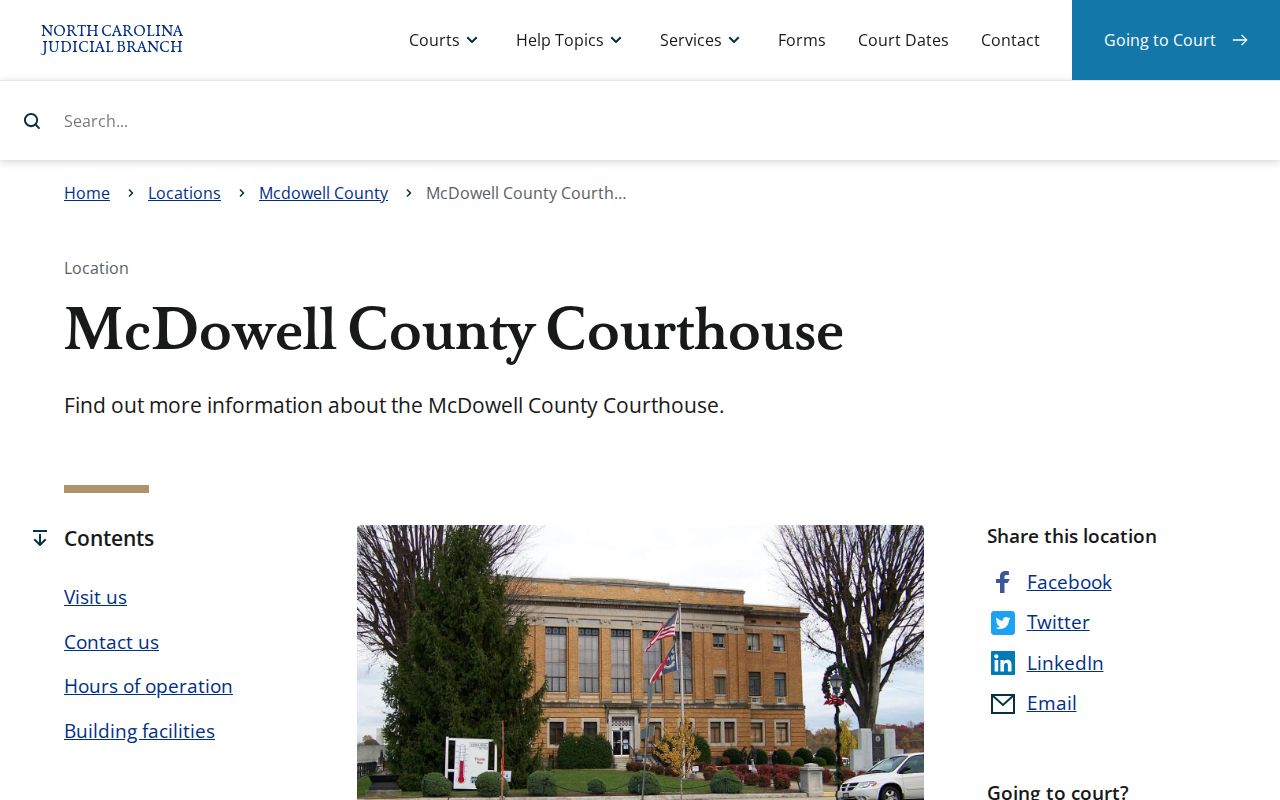
A court result explains the case path, but the Sheriff or NCDAC record remains the source for the actual custody release date.
Find McDowell County Released Inmates
Start with custody type, not a broad name search. The McDowell Sheriff app is a current county-custody clue. It is not a historical release archive. NCDAC covers state prison and state community supervision, not county-jail data. eCourts explains the local case. BOP, ICE, and USMS sources each cover a separate federal path. A result from one system cannot rule out custody in another.
- Collect name variants, date of birth, booking or offender number, arresting agency, and approximate dates.
- Check the Sheriff app for current county custody, then call detention staff if the person is absent.
- Ask whether the last county event was release, transfer, extradition, or pickup and request the written disposition.
- Search the McDowell court case for the bond order, judgment, dismissal, or state commitment.
- Use NCDAC when state prison or supervision applies, and read actual release separately from active supervision.
- Use the federal or immigration channel only when that authority may have received the person.
- Reconcile the agency names and timestamps before treating the event as confirmed.
County-jail release and state-prison discharge follow separate paths through the McDowell County Detention Center and Marion Correctional Institution. Exact historical proof still comes from the agency record, not a missing live result.
McDowell NCDAC Release Search
The NCDAC General Offender Public Information Search covers current state prisoners, probationers, parolees, and historical state records. It expressly excludes county-jail data. An offender number is the most precise input. Name, Soundex, sex, race, ethnic group, date-of-birth range, age range, and status can narrow a search when the number is unknown.
| Search field | Use | Release-reading note |
|---|---|---|
| Offender number | Direct match, up to seven digits | Compare identity and sentence record |
| Name and Soundex | Find spelling variants | Confirm with date of birth and docket |
| Status | Inactive or active supervision | Incarceration and supervision differ |
| Date or age range | Separate similar names | Do not publish more identity data than needed |
| County and docket | Connect the state record to the case | McDowell refers to the case or release location context |
The state search form is the official entry point for a McDowell County person who entered NCDAC custody.
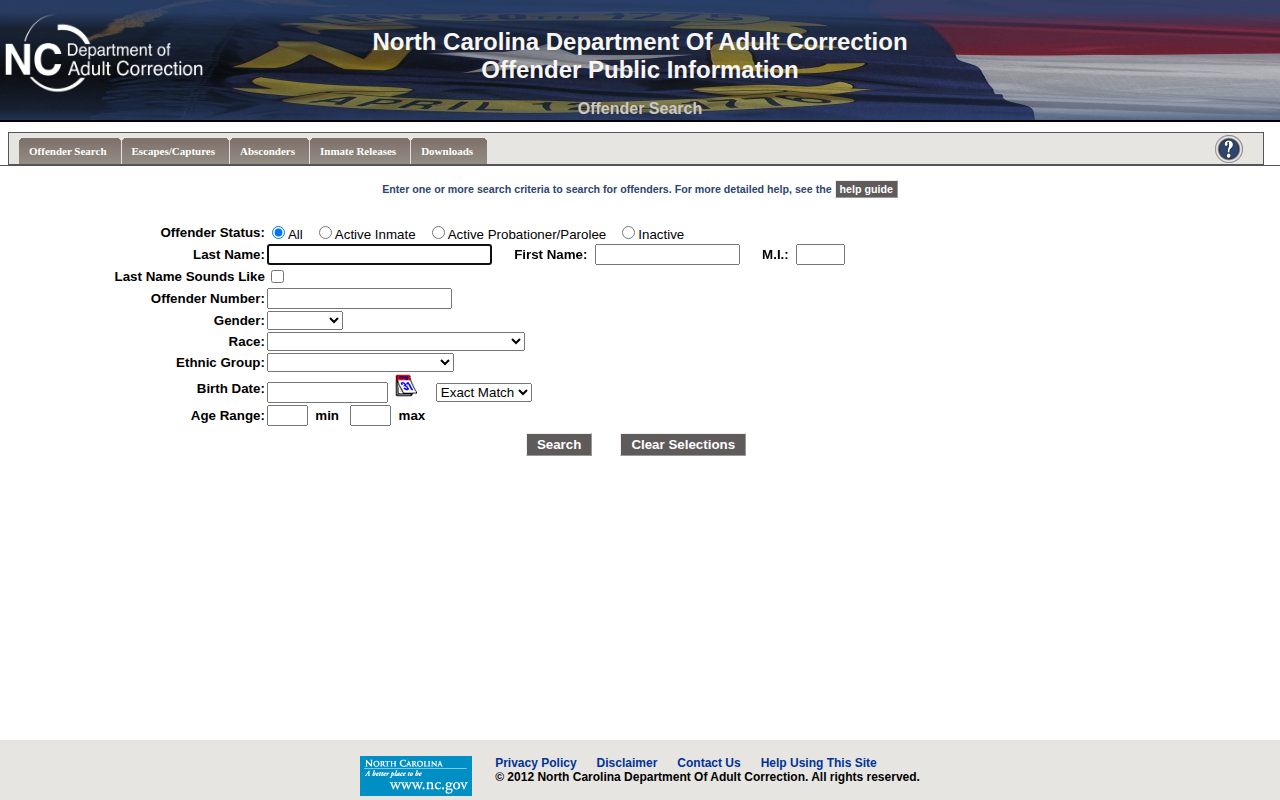
Open the matching profile and compare “Inmate Status,” supervision status, Actual Release Date, Projected Release Date, county, and docket rather than relying on the results list alone.
McDowell State Release Results
NCDAC also has a dedicated Inmate Release Search. It can select McDowell by year and month or use a surname. Results observed in the research show offender number, name, Release Date, Primary Offense with a qualifier, and Type of Release. Types can include expiration and parole-related entries.
This is a state-designated release-county or location search. It is not the McDowell Sheriff’s jail-release log. Its strength is finding NCDAC releases connected to McDowell and then opening the state history. Its recent rolling year selector also differs from the general offender search’s much longer historical coverage.
Do not combine NCDAC monthly release results with county-jail releases. They are separate records produced by different custodians.
McDowell Released Versus In Custody
The same name can appear differently across systems because each source answers a separate question. Current custody means an agency presently reports confinement. A released status closes one episode. Active supervision can continue after state confinement ends. A transfer leaves the person in custody even though the sending roster no longer shows them.
| Source | Best for | Critical limit |
|---|---|---|
| Sheriff app and detention line | Current McDowell jail custody | No published release archive or recent-release window |
| Sheriff release record | County release time, reason, authority, or transfer | Must be requested from the custodian |
| eCourts | Bond, disposition, judgment, and sentence basis | Not the exact jail exit time |
| NCDAC | State incarceration, actual release, and supervision | Excludes county-jail data |
| NC SAVAN/VINELink | Custody event alerts from a reporting agency | Not a certified historical archive |
| BOP or ICE | That federal agency’s custody or release status | No result cannot exclude another authority |
McDowell Federal Release Transfers
McDowell County states that its detention center houses U.S. Marshals Service detainees. This makes a federal pickup a real local branch, not a remote possibility. A person can disappear from the county’s current search because USMS received them. That event is a transfer into continuing federal custody unless the federal record shows otherwise.
The BOP inmate locator covers sentenced federal prisoners from 1982 forward and may show a release date, location, “Released,” or “Not in BOP Custody.” It does not cover every federal pretrial detainee. The ICE Online Detainee Locator System uses exact identity inputs and offers limited recent-release coverage for its own system. For a USMS pretrial path, use the federal docket and a specific USMS records request when appropriate.
McDowell Release Alerts and Supervision
North Carolina brands VINE as NC SAVAN. The service can send notice of release or other custody events from participating county-jail and NCDAC feeds. Open the record from the correct reporting agency, read the event date and status, and then confirm the event with the Sheriff or NCDAC. A released notice closes the selected source episode. It does not rule out transfer, a later booking, federal custody, or active supervision.
State supervision is verified through the NCDAC profile and Community Supervision office listing. Probation is a court-ordered community sentence. Parole is discretionary release mainly associated with eligible older-law cases. Post-release supervision is the mandatory community portion for many Structured Sentencing felonies. The McDowell County parole and probation page explains how to read inactive incarceration beside active supervision.
McDowell Release Reentry Resources
NCDAC lists a McDowell Reentry Council with a local contact at 828-559-2224 extension 206. The council organizes resources around family, transportation, substance use, legal needs, and advocacy. The link matters because Marion Correctional Institution sits in McDowell County and North Carolina’s Pathway Home 6 guidance specifically connects that prison and county to planned reentry continuity.
The official NCDAC Local Reentry Council directory is the best source for current council details. Reentry help is not proof of release, supervision, or sentence completion. Confirm legal status in the responsible custody record before using services as a status signal.
Transportation After McDowell Release
McDowell County Transit is demand-response service, not a documented walk-up shuttle from the jail. Requests ordinarily must be made by 10 a.m. on the day before service, while Monday trips are requested by Friday. Pickup and drop-off need to be arranged. No official source promises a jail stop or a same-day ride timed to release processing.
A person planning for release can ask dispatch about eligibility and pickup at 828-559-0744; Spanish assistance is listed at 828-652-0727. The county transit page should be checked before relying on a trip. Release timing can change, so transportation planning must remain separate from the custody confirmation itself.
Marion Prison Release History
Marion Correctional Institution is a 793-capacity NCDAC prison, not a Sheriff jail. Its official history ties the site to McDowell County’s donation of the former Carl Holland Farm. Grading began in 1992, construction ended in January 1995, and the prison began receiving people in June 1995. Those facts explain why a state facility and county jail may both appear in a local search while producing very different records.
The official Marion Correctional Institution page describes the adult male close/minimum facility. A move to minimum custody, work release, or another NCDAC prison is not final discharge. Community release belongs in the statewide NCDAC history, with Actual Release Date and any active supervision read together.
McDowell County Release Facilities
Two verified detention or correctional facilities serve distinct release paths in McDowell County. The county jail holds pretrial detainees, short-sentence prisoners, and some USMS detainees. Marion Correctional Institution holds sentenced state prisoners. No separate long-term Marion municipal jail, BOP prison, or ICE detention center was verified inside the county.
| Facility | Custody type | Where release appears |
|---|---|---|
| McDowell County Detention Center | County jail and USMS holding | Sheriff release record, court case, or receiving authority |
| Marion Correctional Institution | NCDAC state prison | NCDAC offender history, actual release date, and supervision status |
A Marion Police arrest normally enters the county and court system rather than a separate city jail. A state-prison result should never be described as a county booking, and a county transfer should never be described as a completed prison discharge.